Gesso and Stura river Park
Overview
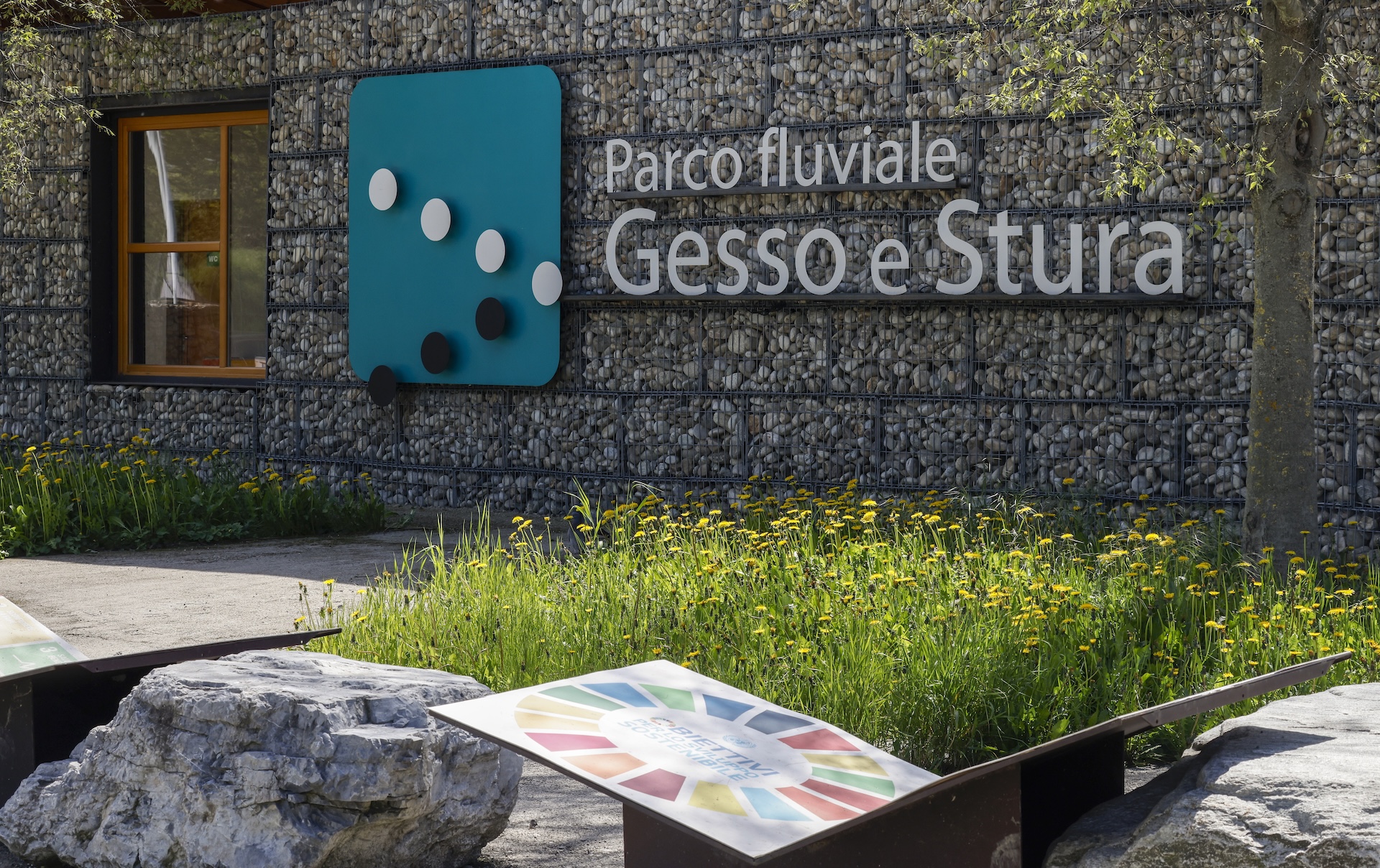
The Gesso and Stura River Park was established by Regione Piemonte in 2007 as a protected area.
It stretches from the foothills of the Alps down to the Fossano and Cuneo plains along the Stura River and Gesso Stream.
The Park includes a total of 14 municipalities: Borgo San Dalmazzo, Castelletto Stura, Centallo, Cervasca, Cuneo, Fossano, Montanera, Rittana, Roccasparvera, Roccavione, Trinità, Salmour, Sant'Albano Stura, Vignolo.
The Park is a ecological corridor connecting mountains and plains.
Within the park you can find:
- areas with high natural beauty and biodiversity;
- areas designed to enhance the visitor experience;
- welcoming facilities;
- facilities for educational activities.
The animals recorded within the Park include:
- 13 native fish species and two alien species.
Species of high Community interest:
- the rare Po River lamprey (Lethenteron zanandreai);
- the lasca (Protochondrostoma genei);
- the scazzone (Cottus gobio);
- the marble trout (Salmo marmoratus), rare in its pure form and often hybridised with the brown trout (Salmo trutta, Atlantic evolutionary line);
- the river crayfish (Austropotamobius pallipes).
- 220 species of resident, wintering, and migratory birds.
Species of Community interest:
- 17 nesting birds, including the little bittern (Ixobrychus minutus), little egret (Egretta garzetta) and short-toed eagle (Circaetus gallicus);
- 7 considered SPEC 1, i.e. species of global conservation interest, including the ferruginous duck (Aythya nyroca), lesser kestrel (Falco naumanni) and red-footed falcon (Falco vespertinus);
- 22 SPEC 2, i.e. species with an unfavourable European conservation status, with populations concentrated in Europe, including the spoonbill (Platalea leucorodia), red kite (Milvus milvus) and sandwich tern (Sterna sandvicensis);
- 47 SPEC 3, i.e. species with an unfavourable European conservation status, not concentrated in Europe, such as the bittern (Botaurus stellaris), glossy ibis (Plegadis falcinellus) and common snipe (Gallinago gallinago).
Some rare in Piedmont during migration, such as the common scoter (Melanitta nigra), the goldeneye (Bucephala clangula) and the pygmy cormorant (Microcarbo pygmeus).
- 37 species of mammals, excluding alien species:
- 16 species of bats, all listed in Annex II, IV or V of the Habitats Directive;
- red squirrels (Sciurus vulgaris);
- roe deer (Capreolus capreolus);
- wild boar (Sus scrofa);
- wolf (Canis lupus), present since 2020;
- red deer (Cervus elaphus);
- stone marten (Martes foina);
- pine marten (Martes martes);
- hazel dormouse (Muscardinus avellanarius);
- water vole (Arvicola amphibius);
- porcupine (Hystrix cristata).
- 56 species of diurnal Lepidoptera, including:
- 5 Hesperiidae;
- 2 Papilionidae;
- 9 Pieridae;
- 16 Lycaenidae;
- 24 Nymphalidae.
Lycaena dispar and Maculinea (Phengaris) arion, which has not been sighted since 2022, are included in the Habitats Directive.
- 41 species of dragonflies, including rare species such as:
- Coenagrion caerulescens;
- Coenagrion scitulum;
- Coenagrion mercuriale;
- Coenagrion mercuriale castellani;
- Erythromma lindenii;
- Sympetrum depressiusculum;
- Oxygastra curtisii, of high Community interest.
- 8 native reptile species and one non-native species, the American pond turtle.
Among the native species, five are listed in Annex IV of the Habitats Directive:
- common wall lizard (Podarcis muralis);
- western green lizard (Lacerta bilineata);
- viperine snake (Natrix maura);
- dice snake (Natrix tessellata);
- green whip snake (Hierophis viridiflavus);
- Aesculapian snake (Zamenis longissimus).
- 9 species of amphibians.
Seven of them are listed in the Habitats Directive:
- Balearic toad (Bufotes balearicus);
- Italian tree frog (Hyla perrini sp. Nov.);
- common frog (Rana temporaria);
- agile frog (Rana dalmatina);
- Lessona's frog (Pelophylax lessonae);
- edible frog (Pelophylax esculentus);
- Italian crested newt (Triturus carnifex).
A hybrid of Pelophylax esculentus, the common green frog, is also present.
The vegetation is typified by:
- vast floodplain forests, which are ecosystems that form in areas with high water levels. They are defined by the presence of oak and black alder trees and are shaped by periodic flooding from rivers and the presence of springs that contribute to water stagnation;
- grasslands;
- arable land and areas for timber cultivation;
- rare plant species:
- Anacamptis coriophora;
- Ophrys holosericea;
- Alyssum alyssoides;
- Lithospermum officinale;
- Melampyrum italicum;
- Myricaria germanica.
The fossil forest emerging from the Stura River in Fossano is a unique and rare geological phenomenon.
Dating back 4 million years, it re-emerged in 2016 due to river erosion.
It consists in a stack of logs and stumps, with trees in a living position belonging to the extinct species Glyptostrobus europaeus.
The Park's management priorities are:
- protecting biodiversity;
- protecting water resources and wetlands;
- managing the river basin;
- mitigating the effects of climate change;
- the environmental education.
Library
The Park's library holds 800 volumes, as well as studies and research on environmental issues.
Activities
The Park provides:
- environmental education activities for students of all levels;
- events and initiatives for the general public;
- foot and bike touring trails;
- bicycle rental;
- f'Orma sensory space for barefoot walking;
- Infopoint.
Gallery

Partner Museums
Cuneo (CN)
The River House
 Botany
 LIBRARY
 ZOOLOGY
 Mineralogy, Petrography, Geology
 PALAEONTOLOGY
 Entomology
 Other
Other
Cuneo (CN)
Appunti Museum
Botany
ZOOLOGY
Mineralogy, Petrography, Geology
PALAEONTOLOGY
Entomology
Other
Cuneo (CN)
Educational Garden
Botany
ZOOLOGY
Mineralogy, Petrography, Geology
Entomology
Other
How many things can one learn about the natural world? Find it all out at the Regional Museum of Natural Sciences!